
The brief
Public health communicators are fighting an uphill battle. Years of politicized, inconsistent and one-size-fits-all communication have left many Americans skeptical of the institutions designed to keep them healthy. For this SCAD research project, we set out to understand exactly why trust had eroded, and to build a framework that could help communicators earn it back.
The process
Over seven weeks, we conducted secondary research, stakeholder interviews, surveys, and participatory research activities, collecting hundreds of data points across medical professionals, public health communicators and the general public. The methodology was rigorous, but the key was translating the research into insights.
We found four specific, recurring gaps:
Trust: Participants consistently rated individual practitioners like doctors, pharmacists and nurses as more credible than the institutions behind them.
Accessibility: Respondents described existing public health communications as confusing, overwhelming and complicated. Language and delivery weren’t meeting people where they were.
Transparency: Skepticism wasn’t about the science, it was about the motive. Who was funding it? Who was benefiting? What was being left out?
Coordination: Public health communicators themselves were often siloed, working in disparate organizations with no shared space to exchange strategies. The same problems were being solved from scratch again and again.
The deliverable
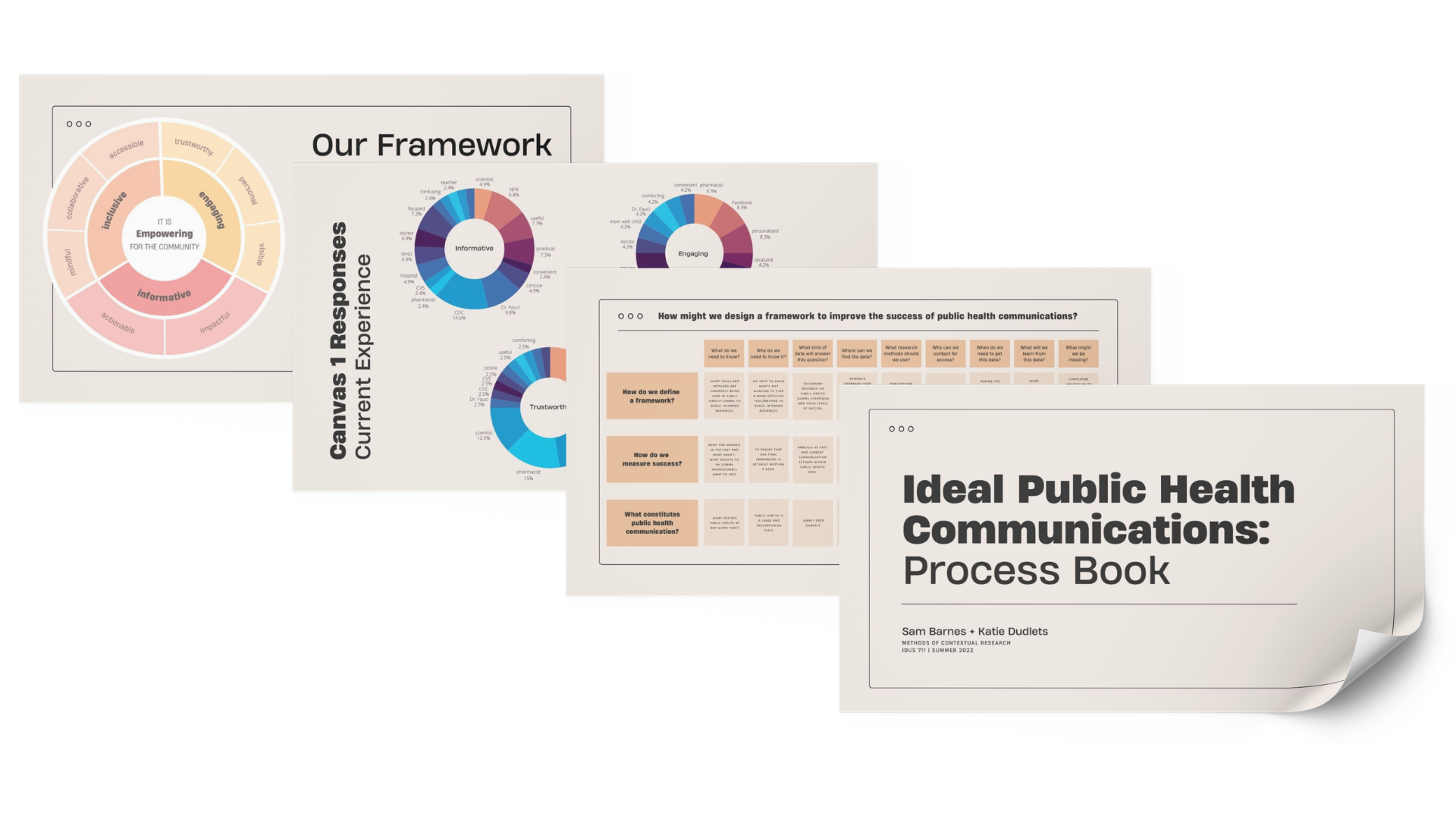
We synthesized hundreds of data points and our four core insights into a communications framework built on three principles.
Inclusivity: To close the accessibility gap, inclusive communication is mindful of socioeconomic and cultural barriers, invites collaboration from the communities it serves and delivers information in a form that people can actually use.
Engagement: To close the trust gap, engaging communication leads with a messenger the audience already trusts (a nurse, pharmacist, or community leader) rather than an anonymous institutional authority.
Information: To close the transparency gap, informative communication is explicit about what it’s asking of its audience, why, and what the measurable impact should be. It forces accountability and gives the broader public health community a shared sta
This framework also closes the coordination gap, giving the public health community a shared standard to build toward together—crafting messaging that actually builds trust.
The results
The framework reframed the core question. Instead of asking “how do we get people to listen,” it asks “how do we become worth listening to?”
It’s a deceptively simple shift, but it changes everything about how you approach an audience, moving from broadcast to dialogue, assumption to understanding, skepticism to trust. Together, our three principles offer public health professionals a practical, research-backed way to close those gaps.
Good research has a way of doing that—not just answering the question you started with, but clarifying the one you should have been asking all along.